Facebook Pixel

How to Create a Diversity and Inclusion Program

Are you seeking to create a diversity and inclusion team to either launch your diversity and inclusion program or boost its progress? Leveraging a group of employees to act on behalf of the company – and guide the process – can help propel your organization to the next level of inclusion and belonging.

Here are five steps that can help you create a diversity and inclusion team that is responsible for educating employees on diversity.

Understand Your Company’s Current Challenges

Before creating a diversity and inclusion team, explore the existing challenges your organization is experiencing in terms of diversity, equity, and inclusion. For example, perhaps your company takes advantage of employee referrals. While referrals often have benefits, they can also create a homogenous workforce – and repel diverse candidates. Being aware of challenges from the outset can help give your diversity team a clear mission.

Establish a Framework for Your Diversity and Inclusion Program

Create a plan for how your diversity and inclusion program will take shape, including the formation of your D&I team and other cultural diversity solutions.

If you already have a thriving DEI program, consider how your team will integrate into and benefit your existing program. Here are some best practices to keep in mind:

  • Define the roles and responsibilities of your diversity and inclusion team.
  • Identify partners for key initiatives.
  • Establish accurate representation.
  • Determine membership expectations and how to recruit new members for your DEI team.
  • Track and communicate progress.

Get Executive Support and a Budget

Your diversity and inclusion initiatives should come from the top down, while also being employee-led. This will ensure you have the proper infrastructure or budget to support the commitments you make in the workplace to diversity, equity, and inclusion.

When you build a team to oversee your diversity and inclusion program, you create an avenue for employees to be directly involved with diversity and inclusion. When you bring in partners from the C-Suite – as well as HR, Legal, and Finance – you’ll be better able to implement DEI initiatives.

Identify Your Mission and Focus Areas

Write a mission for your diversity and inclusion team, ideally one that’s in sync with your company mission. You’ll want to make it broad enough to be inclusive and evolve with the company.

Here’s an example mission statement:

We believe every person has equal value, which is why we work hard to expand fair and transparent access to [insert services] and to welcome all kinds of people and their ideas. Our diversity and inclusion team combats discrimination. It promotes respect, inclusion, opportunity, and community in our workplace. It has four elements, including messaging and metrics, attraction and recruitment, inclusion and retention, and community and partnerships.

Build a Strategy and Set Goals for Your DEI Team

Build a strategy for your team. If you follow the same structure as the mission statement above, here’s what each of the four teams will focus on:

  • Messaging and metrics: Practice inclusive messaging practices and track employee demographics.
  • Attraction and recruitment: Source diverse candidates from a variety of backgrounds and create fair hiring processes.
  • Inclusion and retention: Raise awareness of identity in the workplace and cultivate an inclusive community.
  • Community partnerships: Engage with lower-income communities and underrepresented groups.

Having a solid plan in place can help your diversity and inclusion program gain traction within your organization. While it may take time to make progress and feel fully integrated with other elements of your DEI program, you’ll get there eventually! Stay humble, learn from experience, be open to feedback, and foster your passion.

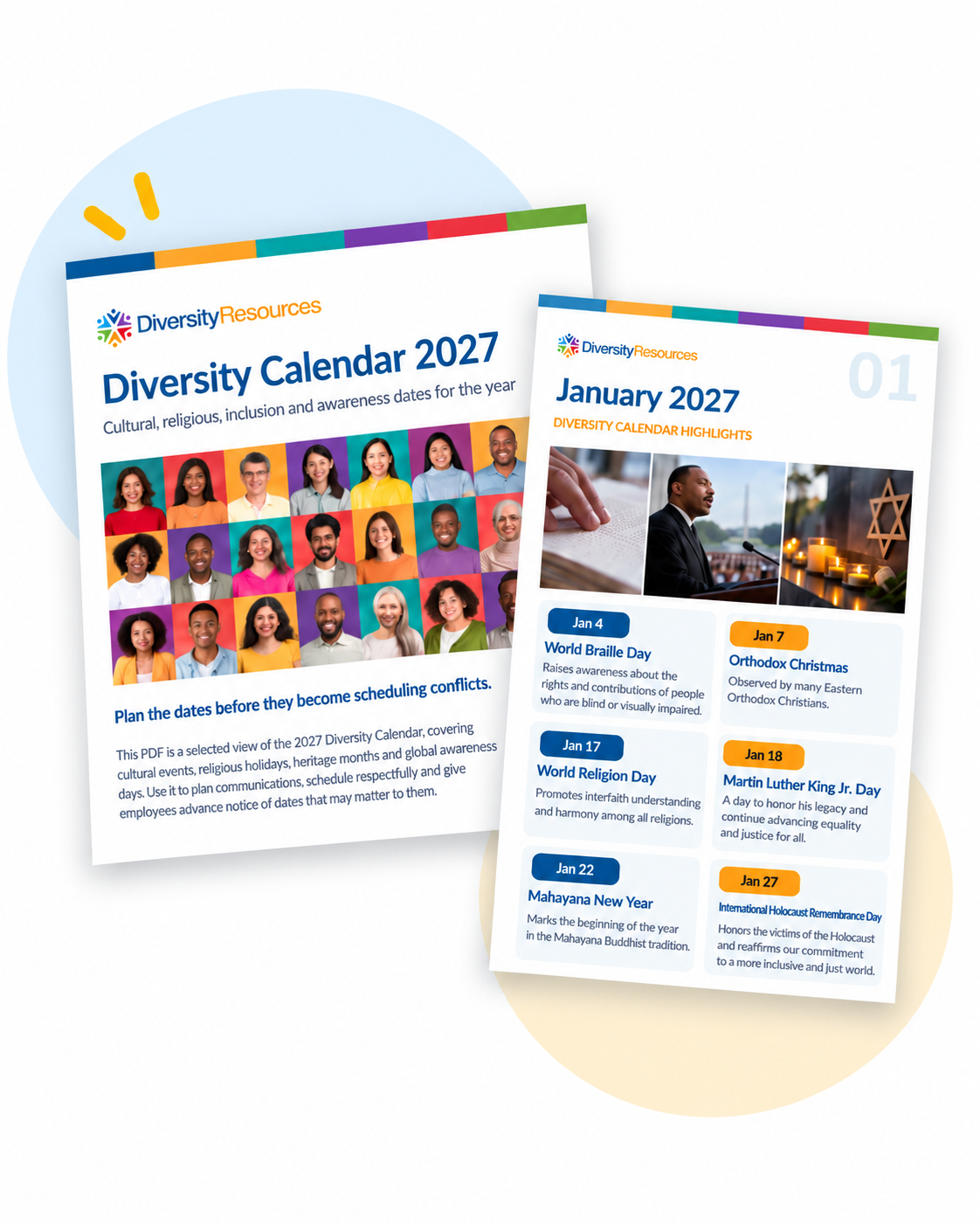
And make sensitivity a part of your workplace, 365, with our Diversity Calendar.

Diversity and Inclusion Program FAQs

What is a diversity and inclusion program?
A diversity and inclusion program is an effort by an organization to create a workplace that welcomes and celebrates a range of different backgrounds, identities, and perspectives. The program aims to foster an inclusive environment where employees feel valued, respected, and empowered, regardless of their race, gender, ethnicity, age, sexual orientation, or any other characteristic. The ultimate goal is to enrich the organization’s culture, improve employee satisfaction, and boost overall performance.

What is an example of a diversity and inclusion program?

An example of a diversity and inclusion program could be an organization implementing unconscious bias training for its staff. Alongside this, mentorship programs for underrepresented employees and channels for feedback and open dialogue about diversity issues could be part of the initiative.

What should a diversity program include?

A comprehensive diversity and inclusion program should include various elements such as diverse recruitment practices, diversity training sessions, and clear pathways for reporting discrimination or harassment. Additionally, a dedicated diversity and inclusion team should be in place to oversee and implement these initiatives. This specialized team is responsible for developing strategies, setting benchmarks, and tracking progress. Employee Resource Groups (ERGs) for various identities and backgrounds can also be beneficial in making employees feel more included and providing a platform for them to voice their concerns and needs.

Religious Demographics in the United States and Globally

The landscape of American faith is transforming. A glance at the nation’s religious demographics from recent years tells a story of change. In 1965, religion was a cornerstone for 70% of Americans. Since then, this sentiment has narrowed to 47%.

But these aren’t just idle claims; they’re echoed in declining church attendance. While many Americans align with a faith, a shrinking number practice it ceremonially. Recent polls show a dip to 29% in weekly service attendance from the 44% reported in 2000 and an even higher historical contrast with 1958’s figures.

The drop in attendance parallels a decline in religious affiliation, notably among Protestants and Catholics. This reflects a broader global narrative where religious growth is robust in regions like Africa and Asia, contrasting the trend in Western nations.

Global Trends in Religious Growth

The religious landscape is undergoing notable changes globally, with certain faiths expanding rapidly in areas outside of Western Europe and North America. Islam is at the forefront of this growth, with its adherents increasing at a rate twice that of the global population surge. Projections suggest a 70% rise in the world’s population from 2015 to 2060, with Islam leading the way in expansion.

Christianity is also experiencing significant growth, expected to see a 34% increase, largely fueled by demographic trends in Africa. Despite this surge, Christianity may not maintain its position as the preeminent global religion in the long run.

Other religions show varied patterns of growth. Hinduism is set to increase by 27%, influenced by steady birth rates, while Judaism is projected to rise by 15%, attributed largely to the high fertility rates found within ultra-Orthodox communities. Meanwhile, the segment of the religiously unaffiliated is likely to experience a marginal growth of about 3%.

The driving forces behind these shifts are predominantly natural population changes—births and mortality—rather than conversion. Higher fertility rates among Muslims, Christians, and Orthodox Jews contribute significantly to their respective growths. However, the global Christian population is also facing a disproportionately high mortality rate, which affects its overall growth trajectory.

Evolving Religious Demographics in the U.S.

In the U.S., the last two decades have seen significant shifts:

  • Christianity’s adherence was reported at around 159 million in 2000, accounting for 76.5% of the population, which increased in proportion by 2010.
  • The unaffiliated and other minority religions have experienced growth, a trend that suggests a pluralistic evolution in religious identity.

The COVID-19 pandemic further impacted religious participation, with recorded lows in attendance. This invites speculation on the broader implications for community worship practices and religious engagement.

Religious influences permeate various societal aspects, from cultural norms to global politics. As the world evolves, so too does the tapestry of belief that binds and divides us. Understanding these dynamics is key to grasping the motivations behind many global events and changes.

Global Religion by the Numbers

As of 2010, Christianity remained predominant among world religions but with changes afoot. Here’s how the numbers stack up, keeping in mind that newer reports may shift these standings:

  • Christianity: 2.2 billion followers
  • Islam: 1.6 billion followers
  • Hinduism: 1 billion followers
  • Secular/Nonreligious/Agnostic/Atheist groups: 929 million people
  • Buddhism: 500 million
  • Folk Religions: 400 million
  • Judaism: 14 million
  • Other religions (e.g. Baha’i, Jainism, Sikhism, Taoism, Wicca, Zoroastorism): 58 million

As these trends evolve, we continue to witness the unfolding story of faith and its role in human society.

Religious Demographics FAQs

What is the breakdown of religions in the United States?
The breakdown of religions in the United States reflects a diverse religious landscape. Christianity remains the largest religion, with Protestants and Catholics forming the majority. Other represented faiths include Judaism, Islam, Buddhism, and Hinduism, alongside a significant portion of the population identifying as non-affiliated or non-religious, which encompasses atheists, agnostics, and those who do not align with any particular religion.

What are the top 3 religions in North America?
The top three religions in North America are Christianity, Judaism, and Islam. Christianity is prevalent across much of the continent, with a large majority in the United States, Canada, and Mexico. Judaism has a strong presence, primarily in the United States, with significant communities in Canada as well. Islam, while smaller in comparison to Christianity and Judaism, has been growing steadily and has a significant and increasing presence in North American countries.

What percentage of the US population considers themselves religious?
Approximately 47% of the U.S. population considers themselves religious, which includes varying degrees of engagement ranging from nominal to very devout practitioners. This statistic shows that, despite a trend toward secularism, a substantial majority still align themselves with some form of religious identity or belief system. However, it’s noteworthy that this includes a range of religious involvement, from occasional to regular worship.


Holiday Greetings Across Cultures

Whether you’re extending holiday cheer or celebrating with friends and colleagues, it’s important to be mindful of diverse traditions and practices. Here’s a guide to common holiday greetings for various cultural and religious observances.

For a list of key cultural religious holidays, please see our global diversity calendar.

Cultural and Religious Holiday Greetings

African American Celebrations

  • Kwanzaa Greeting: Happy Kwanzaa
  • Note: Kwanzaa celebrates African heritage and focuses on seven core principles.

Armenian Observances

  • New Year & Christmas Greetings: Happy New Year; Merry Christmas
  • Note: Armenians may also exchange the greeting, “Christ was born and revealed,” during Christmas.

Baha’i Festivities

  • Naw Ruz and Ridvan Greetings: Happy Naw Ruz; Happy Ridvan
  • Note: It’s considered inappropriate to offer greetings on solemn Baha’i holy days.

Buddhist Ceremonies

  • Visakha Puja (Buddha Day) Greeting: Happy Buddha Day
  • Note: Buddhists may appreciate a simple acknowledgment of this day representing significant events in Buddha’s life.

Cambodian Traditions

  • New Year Greeting: Happy Cambodian New Year
  • Custom: Sharing blessings often involves the playful throwing of water.

Chinese Festivities

  • New Year Greetings: Happy New Year; Gung Hay Fat Choy (Cantonese); Gungshi Shin Nien (Mandarin)
  • Note: While other festivals like the Lantern and Mid-Autumn Moon Festival have no set greetings, good wishes for prosperity and health are always appreciated.

Christian Holidays

  • Easter and Christmas Greetings: Happy Easter; Merry Christmas
  • Note: As Jehovah’s Witnesses do not celebrate these holidays, it’s respectful to avoid these greetings with them.

Hindu Festivals

  • Diwali and Holi Greetings: Best wishes for a joyful Diwali; Happy Holi
  • Note: Greetings wishing happiness and prosperity are suitable for most Hindu holidays.

Hispanic and Latino Celebrations

  • Christmas and Las Posadas Greetings: Feliz Navidad
  • Note: These are times of vibrant community celebrations with family-centric customs.

Islamic Observances

  • Eid al-Fitr and Eid al-Adha Greetings: Eid Mubarak or Happy Eid
  • Ramadan Greeting: Ramadan Mubarak or wishing you a blessed Ramadan

Jain Commemorations

  • Mahavir Jayanti Greeting: As this is a solemn occasion commemorating Lord Mahavir’s birth, greetings are generally not exchanged, but a respectful acknowledgment of the day could be a simple expression of goodwill, such as “Wishing you a peaceful Mahavir Jayanti”

Japanese Celebrations

  • New Year and Other Happy Occasions Greetings: Happy New Year; Omedeto
  • Note: Congratulatory phrases are suitable for joyous events, with no specific greetings for other holidays like Greenery Day or Respect for the Aged Day.

Jewish Holidays

  • Rosh Hashanah, Yom Kippur, and Hanukkah Greetings: L’shana Tova; Have a meaningful fast; Happy Hanukkah
  • Note: “Good yuntef” is an all-encompassing phrase for Jewish holidays

Korean Festivities

  • New Year and Chuseok Greetings: Happy New Year; Blessings of Chuseok
  • Note: Chuseok is a harvest festival without a specific greeting tradition.

Mexican Celebrations

  • Cinco de Mayo: Happy Cinco de Mayo
  • Note: The Day of the Dead is a reflective holiday to honor past loved ones, and thus has no specific greeting.

Sikh Important Days

  • Guru Nanak’s Birthday, Baisakhi Greeting: Congratulations and blessings on this sacred day

Tibetan Observances

  • Losar (New Year) Greeting: Happy Losar or Tashi Delek (a wish for prosperity and good fortune)

Vietnamese Traditions

  • Tet Nguyen Dan (New Year) Greeting: Happy Tet or Wishes for a prosperous New Year

Understanding Eating Taboos and Customs

Eating Taboos: Different cultures have specific dietary restrictions, such as abstaining from beef, pork, alcohol, and non-kosher or non-halal food items. Awareness and respect for these prohibitions show cultural sensitivity and respect.

Utensil Etiquette: Adhering to hand-eating customs and chopstick protocols demonstrates respect for cultural practices. Remember to use only your right hand when eating with your hands and avoid placing chopsticks upright in rice.

Respecting Unexpected Customs

As we navigate the diverse world of holidays and observances, let’s celebrate our differences with respect and cheer. Our global Diversity Calendar can serve as a detailed guide for more inclusive celebrations throughout the year.

Holiday Greetings FAQs

What is a good holiday message?
A good holiday message is one that conveys warmth, kindness, and well-wishes tailored to the occasion. It respects the recipient’s cultural and religious practices and acknowledges the significance of the holiday to them. Such a message often includes sentiments of peace, joy, and gratitude and may reflect on the shared human desires for happiness and community during special times.

What is the politically correct holiday greeting?
To be politically correct, a greeting is inclusive and sensitive to the holiday traditions of all recipients. It aims to express good wishes without assuming the specific holidays celebrated by any individual, thus embracing diversity and promoting inclusivity.

Can I just say happy holidays?
While “Happy Holidays” is a considerate and inclusive greeting suitable for a wide range of festive events, it is important to consider the context in which it is used. It works well for times when multiple holidays take place around the same season, encompassing a diversity of celebrations. However, during periods marked by more solemn or reflective observances, it might not be fitting to use a celebratory greeting such as “Happy Holidays.”

Greetings and Customs Around the World

Understanding cultural do’s and don’ts is a crucial component of diversity training in the workplace. Greetings can vary dramatically from one country to another, with specific nuances for gender and social context adding layers of complexity. To ensure a faux pas-free journey, whether for work or pleasure, it might feel like you need a field guide for international etiquette.

For those looking to deepen their cultural savvy, consider supplementing your know-how with some comprehensive cultural competency training.

Let’s demystify some of these greeting conventions.

A guide through various interesting gestures and greeting cultures

In the United States, a firm handshake accompanied by a friendly “hello” is a one-size-fits-all approach, while cheek-kissing is far less common than in other cultures.

The United Kingdom keeps it cool with a simple “hello” for friends and a handshake when making a new acquaintance. However, don’t be surprised by a quick peck on the cheek in a more casual setting.

France delights in the double cheek kiss, a gesture shared freely among friends and upon arrival and departure—a tradition even the little ones learn.

Japan is known for its respectful bows, a contrast to the casual Western handshake and the warmth of a hug.

In Arab countries, it’s common for close male friends or colleagues to exchange hugs and kisses on both cheeks. When shaking hands, the right hand is used exclusively. Be mindful of interactions between men and women, as direct contact is often discouraged in some contexts.

Hungary offers a lesson in versatility with cheek kisses among friends and firm handshakes upon first introductions.

Belgium‘s universal greeting involves a single cheek kiss, regardless of gender or familiarity.

China opts for more subtlety, with a nod, smile, or handshake reserved for formal interactions.

Russian greetings may be robust—a bone-crushing handshake for men and a softer one for women, with a potential trio of cheek kisses or even a hand kiss thrown in for good measure.

Albania and Armenia show diversity even within Europe, with everything from handshakes to cheek kisses marking different levels of familiarity and social context.

In some Pacific Island cultures, a traditional nose-pressing gesture called the ‘honi’ is similar to the Maori ‘hongi’ and signifies the sharing of one’s breath of life.

In Tibet, sticking out your tongue can be a welcoming gesture, a practice that historically ensured the person you were greeting was not a reincarnation of a cruel 9th-century king known for his black tongue.

In Inuit communities, the ‘kunik’—a form of greeting involving pressing one’s nose and upper lip against someone’s cheek or forehead and taking a deep breath—is a sign of affection typically reserved for loved ones.

Keep in mind, this is just a snapshot of global greetings. Hand gestures, too, can be a minefield of misinterpretation. For instance:

  • A friendly wave in many cultures might be seen as brash or dismissive in East Asian or European contexts, where it could signify “no” or even “come here” as it does in India.
  • The hand counting customs differ interestingly, as Germans and Austrians may interpret your index finger as “two,” and in Japan, a thumb signals “five.”
  • Inviting someone over with a curled fingers motion is generally impolite outside of Western contexts and is often reserved for calling pets in places like the Philippines and East Asia.
  • Pointing with an index finger is considered rude in many cultures, emphasizing the importance of using hand gestures judiciously. Gestures often speak louder than words, so it’s wise to be as attentive with our hands as we are with our language.

Embrace the world’s diversity with open eyes and, perhaps, reserved hands. It’s not just greetings – different cultures communicate differently as well, so don’t forget to explore global communication styles in the workplace. To navigate holiday greetings and more, subscribe to our Online Diversity Calendar.

Greetings and Customs FAQs

What is greeting in culture?
Greeting in culture is the way people acknowledge each other’s presence and initiate communication or social interaction. It’s a foundational element of social etiquette, varying widely from one culture to another, and is deeply rooted in societal norms, values, and traditions.

What is a traditional greeting?
A traditional greeting is a customary way that people belonging to the same culture acknowledge each other in social or formal settings, which often has historical significance or cultural symbolism. These greetings are part of a community’s heritage and can include specific phrases or conventional gestures passed down through generations. For instance, the Maori hongi, where people press their noses and foreheads together, or the Japanese bow, are traditional greetings that carry deep meaning in their respective cultures.

What is the most popular greeting internationally?
The most popular greeting internationally is arguably the handshake. It is widely recognized and used across various cultures for both casual and formal occasions. Despite its commonality, the way a handshake is performed—its firmness, duration, and accompanying eye contact or verbal greeting—can vary, reflecting the diversity of global customs. However, its prevalence in global business and diplomacy makes it a universally understood gesture of introduction and agreement.

Religious Holidays in the Workplace

Religion and spirituality are gaining importance in workplaces as employers increasingly recognize the benefits of incorporating faith-based practices into their work culture. Such practices, including recognizing religious holidays in the workplace, help provide employees with a sense of purpose and promote overall well-being, leading to increased productivity and better morale.

Creating a work culture that supports diversity and inclusion allows people of all faiths to feel a sense of belonging. This enables easier collaboration and improves workplace relationships, leading to a greater sense of community where employees can thrive.

Using a Diversity Calendar for Religious Holidays in the Workplace

To successfully manage religious holidays in the workplace, a diversity calendar is an invaluable resource. It helps employers navigate various religious holidays and festivals, ensuring inclusive scheduling for all.

How to Successfully Navigate Different Faiths in the Workplace

Navigating different religions can be challenging. However, having a space for an inclusive community ensures that your entire staff feels comfortable practicing their faith at work. Being mindful of religious holidays in the workplace and making reasonable accommodations accordingly shows respect for diverse practices.

Diversity Training and Legal Framework

Diversity training can equip employees with the skills and knowledge needed to interact respectfully with staff members of different faiths. Additionally, legal frameworks such as Title VII of the Civil Rights Act protect employees from discrimination based on their religious beliefs. This allows employees to express their religion in various ways, such as wearing religious attire, reading religious materials during breaks, or openly discussing their faith.

How to Prevent Religious Discrimination at Work

There are several ways to eliminate religious discrimination in your workplace, including:

  • Conduct diversity training sessions
  • Address unconscious bias
  • Offer flexible scheduling for religious holidays in the workplace
  • Accommodate dietary restrictions, such as having a kosher-friendly refrigerator or offering an alternate break room for those observing religious fasting

Implementing these practices, along with a diversity calendar,  can help ensure you are aware of  important religious holidays throughout the year.

Religious Holidays in the Workplace FAQs

How Should I Accommodate Religious Holidays in the Workplace?

Reasonable work arrangements include modifying an employee’s work schedule for religious observances or holidays. Flexible scheduling allows them to come in early or stay late depending on their needs, especially useful for those fasting during the month of Ramadan. Offering floating holidays in employee benefits allows them to use this personal time off as they see fit throughout the year.

Do Employers Have to Legally Adjust Work Schedules for Religious Holidays?

Title VII of the Civil Rights Act of 1964 requires employers to reasonably accommodate their employees in terms of religious practices, unless it can cause undue hardship to an employer. However, most scheduling issues can be resolved with the help of a diversity calendar that allows employers to plan ahead.

What Are Microaggressions?

Microaggressions

Microaggressions are one of the 4 essential types of diversity training in the workplace. They’re behaviors or statements that do not necessarily reflect malicious intent, but which nevertheless inflict insult or injury.

The term was first coined after the Civil Rights era – around the late 1960s or early 1970s. During this time, visible and violent expressions of racism were replaced by subtler manifestations. Today, “microaggression” has become a buzzword in the social justice arena, and now we’re breaking it down for you to understand.

What are some examples of microaggressions?

After reading the above definition, do you know what a microaggression is? Can you think of one you’ve witnessed?

If not, we don’t blame you. Unless you’ve learned about them before or been a victim yourself, microaggressions can be tricky to conceptualize. It’s not because they don’t exist – it’s because they’re like implicit biases. Microaggressions and implicit biases are often not “problems” to anyone who isn’t directly impacted by them.

As psychologist, author, and Columbia professor Derald Wing Sue, Ph.D., puts it, microaggressions are “the everyday slights, indignities, put-downs, and insults that people of color, women, LGBT populations, or those who are marginalized experience in their day-to-day interactions with people.”

Here are some examples. See if any of these are familiar to you!

Theme Microaggression Message
Alien in own land “So, where are you from?” You are a foreigner
A White person does not want to acknowledge race “When I look at you, I don’t see color.” Denying a person of color’s racial/ethnic experience
The notion that the values and communication styles of the dominant/White culture are the ideal/”norm” To an Asian, Latino, or Native American, “Why are you so quiet? We want to hear what you think. Speak up more!” Assimilate to the dominant culture
A statement made when bias is denied “I’m not racist. I have several Black friends!” I could never be racist because I have friends of color
Statements that assert that race or gender does not play a role in life successes “I believe the most qualified person should get the job!” People of color are given extra unfair benefits because of their race
White dominant society expect Black folks to be less competent “You’re so articulate or well-spoken.” This remark suggests that they assumed that the person would be less articulate and are surprised to find out that they aren’t

How do microaggressions actually harm people?

Dr. Sue writes that microaggressions cause frustration, self-doubt, anxiety, and cumulative emotional, psychic, and spiritual burden. Unlike macroaggressions – the large-scale, overt aggressions that mostly occur at the systems level – microaggressions are interpersonal. In fact, they commonly occur in academic and professional settings. This means that microaggressions are committed by people you know and in settings you should be comfortable and feel safe in.

How to disarm microaggressions

If you’re commonly on the receiving end of microaggressions, it can be an exhausting experience. How do you disarm them without exceeding your emotional bandwidth? Denise Evans, a certified facilitator of implicit bias and cultural intelligence workshops in West Michigan, suggests using wittiness. She, herself, is black. Here’s an example of how she “throws” microaggressions right back at the individual she’s speaking with.

If an individual tells her that she’s “well-spoken” or “articulate” – a known microaggression – Evans doesn’t miss a beat.

“I have said, ‘Thank you very much, so are you,’” says Evans. She then asks, with a smile, why they felt the need to say anything, including a list of possible reasons in her question: Is it because she’s a native New Yorker? A woman? Black?

And I literally wait for [an] answer,” she says. “I give people their microaggression and their implicit biases back in a pretty box with a nice bow on it. I hand it to you, and I wait for you to open it and tell me what you see.”

While you may find this awkward at first, as an educator, Evans says that these are teachable moments. Brains have made unconscious associations, and we have the power to undo the damaging ones (i.e. “African American and “uneducated or “women” and “assistant”).

Keep following our diversity and inclusion planning articles to learn more.

As well, keep up to date with our 2022 diversity calendar for the upcoming year.

Learn more about Interfaith with our 2022 Interfaith calendar for this year.

Examples of Unconscious Bias in the Workplace

Did you know that despite our best intentions, unconscious bias can seep into our workplace decisions? Picture this: two equally qualified candidates, one male and one female, but one is preferred over the other based on gender. This is just one example of unconscious bias in the workplace.

In part 1 of this post, we explored four different types of unconscious bias. Now, in part 2, we will explore five more types and examples of unconscious bias in the workplace. Unconscious biases are stereotypes about certain people groups that stem from someone’s own subconscious thoughts. These biases stem from the way people tend to organize social worlds into categories.

As we seek to be more inclusive at work, we must be more aware of – and avoid – these biases. Arming your employees with this knowledge and encouraging them to acknowledge these incidents allows you to help reduce unintentional discrimination.

Here are five examples of unconscious bias in the workplace for you to learn from in this Unconscious Bias Training blog.

Examples of Unconscious Bias

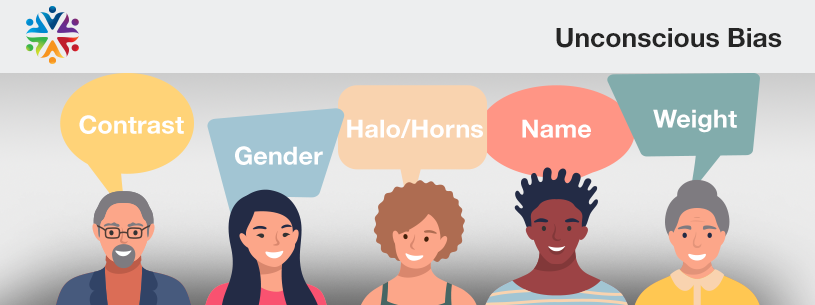
Contrast Effect

The Contrast Effect occurs when you’re comparing two similar things. Typically, this bias distorts our perception of something by comparing it to something else.

Example:  Imagine a situation where two candidates are interviewed back-to-back; the second candidate might appear stronger due to the contrast with the first, even if both are equally qualified.

Gender Bias

Gender bias is a preference for one gender over another. Often, it causes an individual to lean unconsciously toward an individual based on their particular gender and its qualities. These “qualities” normally stem from deep-seated beliefs about gender roles and stereotypes.

Example: Certain terminology on job postings favors one gender over another, leading to gender bias. Workplace microaggression training is one way to help reduce gender bias in the workplace.

The Halo/Horns Effect

The Halo Effect occurs when we focus on one positive attribute of a person, and let that “halo” glow impact our overall opinion. The Horns Effect is the opposite when your entire opinion of someone is affected by one negative trait.

Example: Knowing someone went to an Ivy League school and expecting that they’re otherwise great in everything that they do. An example of the Horns Effect is thinking negatively of someone’s professional work just because you don’t like the way they dress.

Name Bias
Candidates with “white-sounding” names are more likely to be successful at various stages of the recruitment process. The only way to remedy this is to institute a name-blind recruitment process.

Example: One study by the National Bureau of Economic Research found that white names receive 50% more callbacks for interviews than Black American names.

Weight Bias

Weight bias encompasses negative attitudes towards people who are overweight or obese, extending to those with weight-related issues, including eating disorders.

Example: Employees with higher body weight face weight-based inequity in employment including unfair hiring practices, lower wages, fewer promotions, harassment from co-workers, and unfair job termination.

Try Unconscious Bias Training in Your Workplace

Unconscious biases are often based on inaccurate or incomplete information. And while they usually have no ill intent, they can negatively impact who gets recruited or promoted. How do you avoid unconscious bias in the workplace? The first step is to enable your employees to see and name these patterns. Make sure that all team members are always respectful and inclusive with managing unconscious bias training.

Unconscious Bias in the Workplace FAQs

What’s an example of unconscious bias in the workplace?

One example involves the hiring process where male candidates are preferred over female ones even though they have the same education, job experience, and skills.

What are the two most common types of unconscious bias observed in the workplace?

There are many types of unconscious biases that we explained in part one of this post. Some include name bias, confirmation bias, and affinity bias.

What are the three C’s for managing unconscious bias?

Three important messages for managing unconscious bias include curiosity about the topic, courageousness to speak up, and the commitment to change.

Workplace Diversity and Mental Health

May is Mental Health Awareness Month, so it’s a good time be aware and more inclusive of 20% of your workforce and customers.

That’s right, 20%! About 1 in 5 adults have a mental health condition. That’s over 40 million Americans, or more than the populations of 20 US states combined!

The High Cost of Poor Mental Health – the cost for business is huge. A study of 10 major companies revealed depression is the #1 most expensive employee health condition. The total economic burden of depression is more than $210 billion per year.

18% of Employees – In a recent survey, nearly 18% of US workers said they had “experienced symptoms of a mental health disorder in the previous month.” The most common disorders are depression, stress and anxiety, and substance abuse.

The solution? Incorporate mental illness into your organization’s diversity definition. Here’s why:

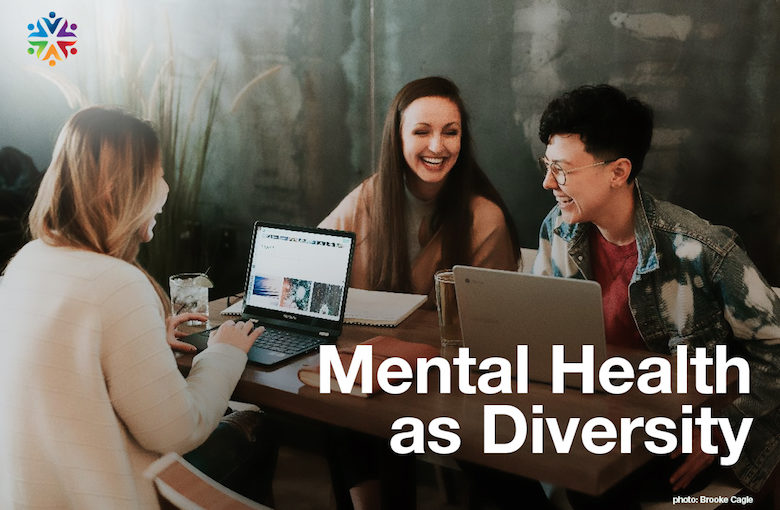
Mental Health as Diversity  – The definition of diversity is: “the state or fact of being diverse, difference, unlikeness.” People differ in race, religion, heritage, sexual orientation and more. They also differ in health: everyone’s health is different.

Include the 20% – Another definition of diversity is “the inclusion of individuals representing more than one national origin, color, religion, socioeconomic stratum, sexual orientation, etc.” It certainly makes good business sense to be inclusive of 20% of the population.

Awareness, Respect and Inclusion – The goal of a diversity initiative is awareness, respect and inclusion, in that order. Be aware of differences. Respectful differences. And be inclusive. Get tips on how in this upcoming new video series on workplace mental health.

Welcome and Destigmatize – Inclusion means welcoming all people, from all ethnicities, genders, sexual orientations, age, religion, etc. It also means welcoming people with disabilities – including mental and cognitive. Together we can work towards improving the lives of those affected, and ending the stigma and discrimination that surrounds mental illness and disorders.

Watch Your Language – For corporate mental health awareness, one starting point is to avoid hurtful language. It’s quite hurtful when people use someone’s diagnosis as an adjective. Avoid phrases such as “he’s totally ADHD,” “she was acting so bipolar,” or “that’s schizo.”

Shout Out – Another option is to give shout outs to famous leaders with mental health or learning disorders. From US presidents to Fortune 500 CEOs, from movie stars to famous musicians, plenty of famous people have suffered from mood or cognitive illness.

Wellness Benefits – What’s the benefit of including corporate mental health programs in your training? If a business runs a factory, it makes good sense to keep its machinery in good order. People are even more important than machines, so it makes good business sense to keep your human resources running at peak performance.

Wellness ROI – Workplaces that make the effort and investment in corporate mental wellness, to ensure their employees are healthy – mind, body and spirit – reap tremendous ROI. Some 80 percent of employees treated for mental health problems report improvements in productivity and jobs satisfaction, according to the Center for Workplace Mental Health. And it’s just a lot more productive and enjoyable to have happy, focused employees.

Learn about some of the medical awareness months 2024 here.

Black Lives Matter Movement and the Workplace

On May 25, 2020, George Floyd, a Black man, who was murdered by a white police officer in Minneapolis, Minnesota, during an arrest. Nearly a year later on April 20, 2021, ex-police officer Derek Chauvin was found guilty of the murder of George Floyd. When this injustice took place, many of us marched in streets, donated to bail funds or racial justice organizations, adjusted workplace practices, and reached out to friends and family members. Are we still doing that? Are we still consciously working on and rebuilding the broken pieces of our society?

As racial tensions continue, it’s more important than ever that businesses take action alongside their employees. Corporate America has the power to influence change, by supporting Black lives matter in the workplace. In this blog, we’ll discuss 3 ways employers can make Black lives matter in the workplace.

Speak Out and Address What’s Happening

Following Floyd’s death, companies began to issue statements regarding their commitment to diversity and inclusion in the workplace, including Black lives matter training for employees. This willingness to speak out and address what was happening in current events marked a turning point. In the past, corporate culture did not always support doing so.

Make sure your company speaks out and acknowledges the ongoing racial injustices in society. Express solidarity with the Black community and demonstrate your commitment to taking concrete steps toward change. If possible, list your goals and steps for the future. Be sure to take a deep dive, include how Blacks are affected by unconscious bias in the workplace.

Create Space to Listen and Learn

As part of the ongoing effort in the workplace, workplaces should foster Black lives matter company policies, to create a space for discussion about racial issues and find ways to give people of color a voice. How this is done can vary depending on the type of company, size of the company, and discretion of the management team. Consider one of the following options…

  • Hosting a town hall on race for employees, guest speakers, and experts
  • Promoting small group discussions
  • Promoting books, films, TED talks, etc will promote discussion

Whatever you decide to do, make sure the responsibility does not fall on members of the Black community within your workplace. They may be feeling overwhelmed with constantly needing to address systematic racism.

Demonstrate Your Commitment to the Cause

Speaking out and creating space to learn are two great steps towards change…but they aren’t change in themselves. To demonstrate their commitment to change in the workplace, employers should identify and implement tangible steps that they can address Black lives matter diversity and inclusion. Ask yourself…

  • How can I understand the racial inequities in my workplace?
  • How can I endeavor to create diverse and inclusive workplaces?
  • How can I establish programs and continually reassess them to ensure they achieve the goals I set?

Taking the time to learn about different perspectives is important, but no change will come unless businesses are willing to adopt initiatives that create real change.

Final Thoughts

First and foremost, the Black lives matter movement in your workplace should foster a culture of respect and support for Black employees. Demonstrating your support for the BLM movement by protesting racism and addressing the horrific presence of police brutality in our society can help foster dialogue in your workplace. Only then can you and your employees work toward tangible changes together.

Managing Cultural Diversity in the Workplace

From our increasingly diverse domestic workforce to the globalization of business, cultural competence is arguably the most important skill for diversity training in the workplace. Understanding and effectively managing cultural diversity has become not just a necessity but a competitive advantage.

What Is Cultural Competence?

Culture refers to the 7 Essentials of Workplace Cultural Competence: the values, norms, and traditions that affect the way a member of a group typically perceives, thinks, interacts, behaves, and makes judgments.

It even affects perceptions of time, which can impact day-to-day scheduling and deadlines. And it varies by industry, as exemplified by the unique challenges of how to improve cultural competence in healthcare.

Cultural competence, in brief, is the ability to interact effectively with people from different cultures. This ability depends on awareness of one’s own cultural worldview, knowledge of other cultural practices and worldviews, tolerant attitudes towards cultural differences, and cross-cultural skills.

The more different cultures work together, the more cultural competency training is essential to avoid problems.  Cultural problems can range from miscommunication to actual conflict, all endangering effective worker productivity and performance. That’s why managing cultural diversity in the workplace is crucial.

Managing Cultural Diversity in the Workplace

Developing cultural competence results in an ability to understand, communicate with, and effectively interact with people across cultures, and work with varying cultural beliefs and schedules. While there are myriad cultural variations, here are some essential to managing cultural diversity the workplace:

1. Communication: Providing information accurately and promptly is critical to effective work and team performance. This is particularly important when a project is troubled and needs immediate corrective actions. However, people from different cultures vary in how, for example, they react to bad news. People from some Asian cultures are reluctant to give supervisors bad news – while those from other cultures may exaggerate it. Learn more about global communications styles in the workplace.

2. Team-Building: Some cultures – like the United States – are individualistic, and people want to go at it alone. Other cultures value cooperation within or among other teams. Team-building issues can become more problematic as teams are comprised of people from a mix of these cultural types. Effective cross-cultural team-building is essential to benefiting from the potential advantages of cultural diversity in the workplace, and is one of the top benefits of diversity training in the workplace.

3. Time: Cultures differ in how they view time. For example, they differ in the balance between work and family life, and the workplace mix between work and social behavior. Other differences include the perception of overtime, or even the exact meaning of a deadline. Different perceptions of time can cause a great misunderstanding and mishap in the workplace, especially with scheduling and deadlines. Perceptions of time underscore the importance of cultural diversity in the workplace, and how it can impact everyday work.

4. Schedules:  Work can be impact by cultural and and religious events.  The business world generally runs on the western secular year, beginning with January 1 and ending with December 31. But some cultures use wildly different calendars to determine New Years or specific holy days. For example, Eastern Orthodox Christians celebrate Christmas on a different day from western Christians. For Muslims, Friday is a day for prayer. Jews observe holidays ranging from Rosh Hashanah to Yom Kippur.

These variations affect the workplace as people require time off to observe their holidays. For upcoming observances, see our Interfaith Calendar 2024 Highlights.

Now that we’ve explored the intricacies of managing cultural diversity in the workplace, how does one develop cultural competence? Be sure to enjoy part 2 of this article. This exclusive article explores the four components of cultural competence, and strategies, skills and techniques for helping people develop cultural competence.

Types of Unconscious Bias

Unconscious biases are social stereotypes about certain groups of people that individuals form outside of their own conscious awareness. Often when we think about a bias, we think of a deliberate and malicious action against someone else. However, sometimes biases occur without any conscious realization at all. This can lead to problems ranging from microaggressions in the workplace to unintended harassment or racism. Here, we’ll explore types of unconscious bias in the workplace.

Unconscious Bias Training

Microaggressions are an essential component of sensitivity training in the workplace. In this article, you’ll discover some of the different types of unconscious bias examples, which will help you begin to recognize and prevent them in your workplace.

What Are the Different Types of Unconscious Bias?

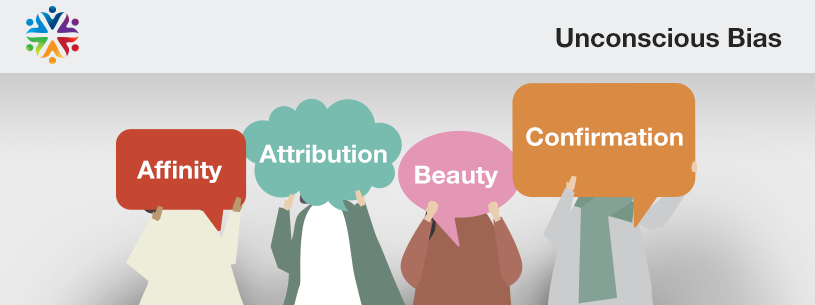
Affinity Bias

An affinity bias refers to our tendency to gravitate toward people similar to ourselves. If you’ve ever wondered why similar people tend to become friends, it’s because of this as we tend to like people who remind us of ourselves or someone we know and like.

Example: If you’re working with an employee who went to the same college or grew up in the same town, you may be more likely to smile or offer encouraging words, compared with an employee with whom you don’t share similarities.

Attribution Bias

Attribution bias contributes to how we assess others and their achievements. When we think of our achievements, we judge ourselves based on our merit and personality. Anything we’ve been awarded, we’ve earned because of our own hard work; anytime we’ve failed, we’ve been adversely impacted by external factors. When we assess others, we often think the opposite. We believe their successes are due to luck, and their failures are due to poor personal error.

Example: When someone cuts a driver off, the individual who was cut off is more likely to attribute their actions to the other driver’s inherent personality traits (.e.g. recklessness, rudeness, incompetence) rather than the situational circumstances (e.g. the driver was late to work).

Beauty Bias

While few people admit to having a beauty bias, many judge others based on their physical appearance.

Example: Seeing a coworker as unprofessional because of how they dress

Confirmation Bias

Confirmation bias involves searching for evidence that back up our existing opinions, instead of objectively looking at all information. Often this causes people to overlook information and to focus on factors that fit only their view and reject evidence that contradicts what they already believe.

Example: A candidate arrives 10 minutes late due to a circumstance outside of their control. Unaware of this, you automatically assume the candidate arrived because they are irresponsible and disorganized. As a result, when interviewing them you focus on information on his or her resume that backs up your preconceived notion.

Conformity Bias

Conformity bias is related to peer pressure and occurs when you allow your views to be swayed by others because you’re seeking acceptance from a group.

Example: Conformity bias often occurs in recruitment. If most people feel one way about a candidate, but you feel differently, you may feel pressured to align with the group’s opinions and views.

How many of these different types of unconscious bias examples have you noticed in your workplace? It’s no surprise that no one is immune to bias. Because of this, we all need to find ways to overcome these unconscious biases at work.

See part 2 of this article, with 5 more Examples of Unconscious Bias in the Workplace. And help your workplace be more inclusive, with managing unconscious bias training.

Types of Unconscious Bias FAQs

How many types of unconscious biases exist?

There are 16 different types of unconscious biases that affect those hiring for a job and in a workplace. These biases encompass a wide range of social, cognitive, and perceptual biases that affect how we perceive and interact with others.

What triggers unconscious bias?

Unconscious bias can affect anyone and is triggered by quick judgments of others. This may be influenced by their background,  their appearance, personal experiences, or other stereotypes. It’s important to understand that these biases can arise from our subconscious, and they are often rooted in societal norms and cultural conditioning.

How do you resolve unconscious bias?

To overcome this unconscious bias in the workplace, first people must be aware of its existence and commit themselves to counteract this bias. This can be achieved through unconscious bias training programs that raise awareness and provide tools to mitigate bias. Additionally, fostering a culture of inclusion and diversity and encouraging open dialogue are crucial steps toward resolving unconscious bias.

Managing Anxiety in the Workplace – 7 Tips

We live in unprecedented times. Anxiety is rampant both in the workplace and in regular life, mostly because of worrying about your health and that of your loved ones, job security, and money. However, by discovering tools for how to deal with anxiety, you can overcome these feelings. Here you’ll find 7 tips to help you overcome stress and worry, which are also helpful for managing anxiety in the workplace.  Any one of these can provide some relief. While they may not completely eliminate your anxiety and stress, you’ll definitely feel more calm.

7 Key Tips

Get Exercise

As little as 30 minutes of cardiovascular exercise gets your blood moving and oxygenates you. But even better, exercise also releases endorphins, nature’s feel-good chemicals. And although your local gym may be closed, there are plenty of alternatives, ranging from going on a brisk walk to doing yoga at home.

Eat Protein

Now more than ever, it’s important to eat a healthy diet. It’s especially important to have protein at every meal because protein provides the building blocks of neurotransmitters that help you feel more calm and cheerful. Also eat lots of whole grains, fresh vegetables, and fruits. Avoid simple carbohydrates (white bread, pasta, pastries) and sugars, which will pick you up but then make you crash.

Get Supplements

A number of wonderful vitamins will help you feel more calm. They’re safe, inexpensive, and have no side effects. These include GABA, l-theanine, inositol, and kava kava. You can quickly order any of these on Amazon.com or most vitamin or health food websites.

Practice Meditation

As little as 10 minutes of meditation, especially early in the morning, will go a long way towards helping you feel calm. Among other benefits, meditation helps calm the mind, by switching your brain from high-beta waves (fight or flight) to delta (deep relaxation). By focusing on your breath, you can more quickly learn to identify thoughts that cause anxiety and dispel them.

Get Connected

As we practice social distancing, it’s more important than ever before to connect with others. Try reaching out to family and friends, and share your feelings: when you feel it, you begin to heal it. There are also plenty of free support groups offering phone meetings, such as Emotions Anonymous.

Challenge Thoughts

It’s said that fear stands for False Evidence Appearing Real, or Future Events Already Ruined.

Practice Mindfulness

Among other tasks, the human mind is designed to identify and provide solutions for danger. But there’s zero benefit to rumination, revisiting the same problems or worries over and over. Try instead focusing on the sound and the feel of your breath, look at clouds or trees, and just being in the moment. Allow your mind to rest.

How Managing Anxiety in the Workplace Helps Improve Productivity

While learning how to manage anxiety is important for work, it’s also important for your regular life too. By taking time to learn these important tips, you can not only feel better every day but also help encourage others to work on their mental health too.

For more information, see this new employee training video: Feel Calm at Work: Tools for Anxiety Video.

Managing Anxiety in the Workplace FAQs

What are workplace triggers for anxiety?
Some causes of work anxiety are dealing with conflict, workplace bullying or discrimination, sexual harassment, meeting stressful deadlines, having a demanding boss, and lack of understanding.

What does anxiety at work look like?
Anxiety attacks can cause you to feel nervous or jittery at work. You may feel restless, fidget a lot, or have trouble sitting still and concentrating.

What to do if my job is affecting my mental health?
Speak to your manager or supervisor to help them put changes into effect that can positively affect the work environment. Chances are you’re not the only one experiencing workplace diversity.

Sign In

Sign in to Diversity Resources