

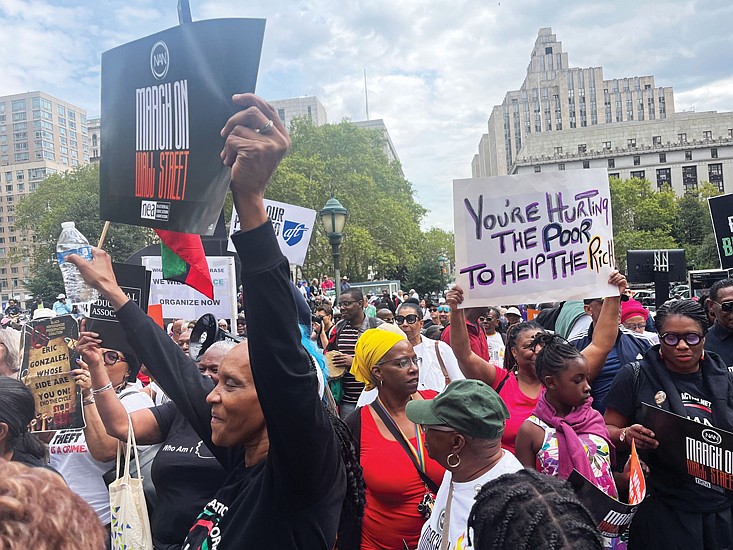
When Rev. Al Sharpton led the recent March on Wall Street protest, timed to honor the anniversary of the 1963 March on Washington, the message was unmistakable. Community, labor, and civic leaders stood shoulder-to-shoulder, urging corporate America to resist growing federal and state efforts to dismantle DEI programs. As faith and civic leaders stressed during the march, this is not a moment to retreat it is a call for companies to meet pressure with principled leadership.
For executives, communicators, and DEI strategists, the Wall Street protest was not just another news cycle. It was a reminder that public activism remains a vital check on corporate behavior and that silence in times like these is itself a decision.
Why the Wall Street Protest Matters for Business Leaders
The protest highlighted a truth that many in corporate suites already know but sometimes hesitate to say aloud: companies are not neutral players in the fight for equity. Employees, customers, and investors are watching. They expect more than polished statements; they expect commitments lived out loud.
Just as the 1963 march forced America to confront the gap between its ideals and its realities, the Wall Street protest asked companies to look in the mirror. Are you standing firm on inclusion or quietly retreating as DEI becomes politicized?

Public Pressure After the Wall Street Protest
Activism and corporate responsibility are more intertwined than ever. Movements in the streets can and do shape boardroom decisions. Consider:
- Reputation Risk: Employees and customers increasingly link brand trust to values alignment. Backpedaling on DEI can trigger backlash that erodes loyalty.
- Talent Competition: The most skilled workers, especially Gen Z and Millennials, gravitate toward organizations that model inclusion authentically.
- Regulatory Signals: Even as federal efforts question DEI, states, municipalities, and global markets are leaning into inclusive practices. Companies that stay ahead build resilience.
The Wall Street protest signaled that activists are not backing down. Neither should corporate leaders.
A Playbook for Corporate DEI in Turbulent Times
So how should organizations respond not just defensively, but boldly? Here’s a practical playbook:
1. Reaffirm Your Commitment Publicly
Do not let silence imply retreat. Issue a clear statement of commitment tied to your company’s values and mission. Reference milestones and progress made, and outline what comes next.
2. Link Inclusion to Business Strategy
Frame DEI not as a compliance function, but as a growth driver. Show how inclusive teams fuel innovation, capture market share, and strengthen resilience in global markets.
3. Support Activism with Action: Lessons from the Wall Street Protest
Engage with movements like the Wall Street protest by aligning philanthropic giving, matching employee donations, or providing space for civic dialogue. Corporate responsibility is not about charity it’s about solidarity.
4. Equip Leaders with Language and Training
Executives and managers must be able to speak credibly about DEI, especially in polarized environments. This includes recognizing that rebranding DEI, as some companies attempt to do by changing the language to “belonging” or “culture,” is not enough if the underlying commitment is diluted. Language alone does not drive progress substance does.
5. Measure and Share Progress Transparently
Commitments without accountability ring hollow. Regularly publish DEI metrics, share case studies, and be honest about where progress is slow. Transparency builds trust.
Looking Ahead
The Wall Street protest was more than a symbolic march it was a call to action. For corporate America, the question is not whether DEI is under scrutiny; it’s whether leaders will stand tall when values are tested.
History shows us that silence is rarely remembered kindly. By affirming their commitments, companies can do more than weather the storm; they can help bend the arc toward justice. Now is the time to show that inclusion is not negotiable it’s non-optional.
Photo credit: Fiona André/RNS