

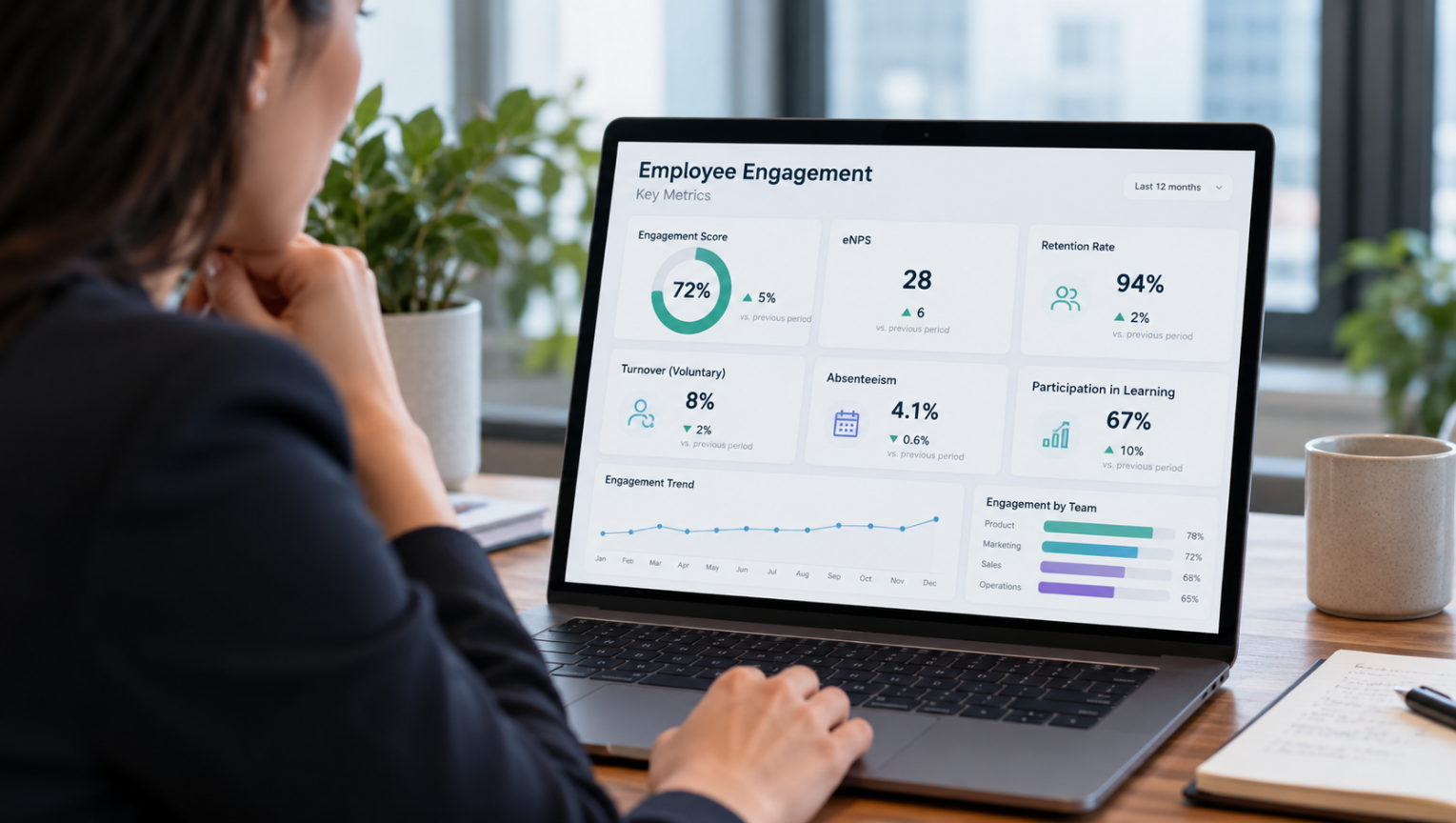
HR teams have access to more workforce data than ever. That doesn’t mean they need to measure all of it. To measure employee engagement effectively, HR needs a focused set of indicators that answers specific business questions, identifies meaningful patterns and helps leaders decide what to do next.
Gallup reported that global employee engagement fell to 20% in 2025, its lowest level since 2020. Manager engagement also declined significantly. Those numbers show why engagement deserves attention, but a company-wide score alone cannot explain what is happening inside a specific organization or what HR should change.
Good employee engagement measurement involves collecting enough useful evidence to answer a clear question and support a decision.
What Does It Actually Mean to Measure Employee Engagement?
To measure employee engagement is to assess how employees experience their work and compare those experiences with relevant workplace behaviors and organizational outcomes.
A useful measurement system should help HR answer questions such as:
- Do employees feel motivated, supported and able to do good work?
- Where are engagement problems concentrated?
- What workplace experiences may be contributing to those problems?
- Are employees staying, developing and participating?
- Are engagement levels improving or declining over time?
- Did conditions change after the organization acted?
This requires more than one metric, but it doesn’t require dozens.
HR can choose from many employee engagement metrics, including surveys, eNPS, retention, turnover, absenteeism, recognition, development participation and internal mobility.
The most useful rule is simple: The business question comes first. The metric comes second.
If leaders are concerned about losing experienced employees, voluntary turnover, retention, intent-to-stay survey responses and internal mobility may be useful. If the concern is declining morale after a restructuring, pulse surveys, confidence in leadership and team-level differences may matter more.
Tracking every available HR metric simply because the data exists usually creates more noise than insight.

How to Measure Employee Engagement With a Focused Set of Metrics
A practical approach to how to measure employee engagement usually combines two types of evidence:
- Employee feedback measures, which show what employees report feeling or experiencing.
- Behavioral and organizational measures, which show what is happening across the workforce.
Neither category is strong enough on its own.
Survey results may reveal frustration before voluntary turnover begins to rise. Turnover data may confirm that employees are leaving, but it cannot reliably explain why. The strongest approach connects employee feedback with relevant organizational evidence.
Use Engagement Surveys to Measure Employee Engagement Directly
A structured engagement survey can measure areas such as:
- motivation and commitment
- role clarity
- confidence in leadership
- recognition
- development opportunities
- manager support
- belonging
- meaningful work
The value of an engagement survey usually lies below the headline score.
Suppose overall engagement is 72%. That may appear positive. But if engagement is 82% among employees with less than two years of tenure and 55% among employees with three to five years of tenure, the segmented result raises a much more useful question: What changes in the employee experience after the first few years?
That gives HR something specific to investigate.
Use Pulse Surveys to Track Employee Engagement Between Larger Surveys
Pulse surveys are shorter and more frequent than annual engagement surveys. They are most useful when HR wants to monitor a specific issue, organizational change or intervention.
For example, after introducing a new performance-management process, HR might ask employees about:
- clarity of expectations
- quality of manager feedback
- confidence in the process
- perceived workload
A pulse survey should have a clear purpose. Sending one every month simply because the survey platform allows it can create survey fatigue without creating better decisions. Pulse surveys are most valuable when the organization is prepared to respond to what employees say.
Use eNPS as an Employee Engagement Signal, Not a Diagnosis
Employee Net Promoter Score, or eNPS, typically asks employees how likely they are to recommend their organization as a place to work. It’s attractive because it produces one simple number. That simplicity is also its limitation.
A declining eNPS may indicate that something is wrong, but it cannot tell HR whether the underlying issue is leadership, workload, compensation, career development, culture or another factor.
Treat eNPS as a signal. If it moves significantly, use more specific survey questions and supporting HR metrics to investigate what may be changing.
Which Employee Engagement Metrics Should HR Track?
Employee feedback should be compared with workforce behavior where the comparison adds useful context. A manageable engagement scorecard may include only four or five behavioral measures, depending on the question HR is trying to answer.
Retention and Voluntary Turnover
Retention shows whether employees are staying. Voluntary turnover shows how many are choosing to leave. Both can be useful employee engagement KPIs, but they are lagging indicators. By the time turnover increases, disengagement may have been present for months.
These measures become more useful when HR compares them with employee feedback about:
- intent to stay
- career development
- manager effectiveness
- workload
- recognition
- workplace experience
Turnover should also be segmented carefully. Losing five employees from one highly specialized team may be more important than losing ten employees across roles with historically high turnover.
Absenteeism as an Employee Engagement Metric
A sustained increase in absenteeism may point to workload, wellbeing, management problems or disengagement. It shouldn’t automatically be classified as an engagement issue.
CIPD’s 2025 Health and Wellbeing at Work research reported average sickness absence of 9.4 days per employee among surveyed organizations, equivalent to 4.1% of working time, while also showing substantial differences between organizations and sectors.
That’s why absence data needs context. If one team has low engagement scores and rapidly increasing absence, the combination deserves further investigation. Absenteeism alone doesn’t establish the cause.
Participation and Development Activity
Participation data can help HR understand whether employees are using opportunities offered by the organization.
Depending on the business question, HR might track participation in:
- learning programs
- employee resource groups
- town halls
- mentoring programs
- development initiatives
- wellbeing programs
- voluntary projects
Low participation doesn’t automatically mean low engagement. Employees may avoid a program because it is poorly scheduled, difficult to access or irrelevant to their role. The number identifies something worth investigating. It does not provide the explanation by itself.
Recognition as an Employee Engagement KPI
Recognition frequency can help HR understand whether employees are regularly receiving acknowledgement for their contributions.
The useful question is not simply: How many recognition messages were sent?
HR should also look at whether recognition is:
- distributed across teams
- reaching different employee groups
- timely
- connected to meaningful work
- consistent with employee feedback about feeling valued
A recognition platform may produce a large amount of activity while employees still report feeling overlooked. High activity doesn’t necessarily mean effective recognition.
Internal Mobility and Employee Engagement Measurement
Internal mobility can be especially useful when employees report limited career opportunities.
HR may examine:
- internal application rates
- internal hiring rates
- lateral movement
- promotion rates
- time since last internal move
- differences between teams or employee groups
LinkedIn Economic Graph research published in 2025 found an association between internal mobility and employee retention across its APAC analysis, including evidence that lateral moves may support retention as well as promotions.
Internal mobility isn’t a direct engagement score. It becomes useful when career opportunity is part of the business question HR is investigating.
How to Measure Employee Engagement by Starting With the Business Question
One of the easiest ways to simplify employee engagement measurement is to make every metric justify its place.
Ask: What decision could change because we know this number?
If nobody can answer that question, the metric probably does not belong on the core engagement dashboard.
Consider three examples.
Question: Why Are Experienced Employees Leaving?
Useful measures may include:
- voluntary turnover by tenure
- intent to stay
- career development survey responses
- manager effectiveness
- internal mobility
Town hall attendance would probably add little unless there is a specific reason to believe it is connected to the problem.
Question: Did Manager Training Improve Employee Engagement?
Useful measures might include:
- manager-support survey items
- recognition frequency
- role clarity
- engagement by manager or team
- voluntary turnover over time
Company-wide recruiting data would probably distract from the question.
Question: Did a Reorganization Affect Employee Engagement?
Useful measures might include:
- pulse survey responses
- confidence in leadership
- role clarity
- belonging
- absenteeism
- voluntary turnover
The right employee engagement metrics depend on the decision HR needs to make.
How Many Employee Engagement KPIs Should HR Track?
There is no universal number of employee engagement KPIs that every organization should use. A core dashboard doesn’t need 20 engagement indicators.
A practical starting point is roughly five to eight core measures, with additional diagnostic measures added only when HR is investigating a specific issue.
For example:
| Measurement area | Possible KPI | What it can tell HR |
| Overall experience | Engagement survey index | Broad direction of employee experience |
| Current sentiment | Pulse survey | Whether a specific issue is changing |
| Advocacy | eNPS | Whether employees would recommend the organization |
| Retention | Voluntary turnover | Whether employees are choosing to leave |
| Attendance | Absence trend | Whether attendance patterns are changing |
| Development | Internal mobility | Whether employees are progressing internally |
| Culture | Recognition | Whether appreciation is occurring consistently |
This shouldn’t be treated as a universal template. Remove any metric that doesn’t help answer an important business question.
A dashboard with seven metrics that leads to three meaningful decisions is more useful than one with 40 metrics that leads to none.
Segment Employee Engagement Metrics Without Creating Statistical Noise
Organization-wide averages frequently hide the most actionable information. This is especially important in employee surveys, where overall results can mask significant differences between employee groups, as discussed in our article on what employee surveys can miss about inclusion.
HR may need to segment employee engagement metrics by:
- department
- manager
- location
- job level
- tenure
- work arrangement
- employee group
Segmentation still requires restraint. Very small groups can create privacy concerns, unstable percentages and misleading conclusions.
A shift from 50% to 75% in a four-person group may simply represent a change in one person’s response.
Focus on segments that are large enough to interpret responsibly and important enough to act on. Then look for patterns across several measures.
A team with declining engagement, increasing voluntary turnover and weak development scores deserves more attention than a team where one survey question moved by three percentage points.
Measure Employee Engagement Through Trends, Not Isolated Scores
A single engagement score tells HR where a metric stands at one moment. A trend shows whether the organization is moving in a positive or negative direction.
This matters because employee engagement measurement can be affected by:
- restructurings
- leadership changes
- busy periods
- layoffs
- acquisitions
- policy changes
- return-to-office decisions
Instead of asking: Is our engagement score good?
Ask: Is employee engagement improving or deteriorating, where is the change happening, and what else changed during the same period?
That question produces a more useful management discussion. The same principle applies to turnover, absenteeism, eNPS, recognition and internal mobility. One month rarely tells the full story.
Do Not Use Employee Engagement Metrics as Proof of Cause
Engagement is associated with many important organizational outcomes, but HR should be careful about causal claims. Large-scale research has found relationships between engagement and outcomes such as turnover, productivity, absenteeism, profitability and wellbeing.
That doesn’t mean a change in engagement automatically caused a change in another metric. Suppose teams with more recognition also have lower voluntary turnover. Recognition may contribute to retention. Strong managers may also create both higher recognition and lower turnover. Compensation, workload, career opportunities, leadership quality or team stability may also be involved.
HR should distinguish between association and proof.
Appropriate: “Teams with lower engagement also experienced higher voluntary turnover.”
Too strong without additional evidence: “Low engagement caused employees to leave.”
Employee analytics should help HR test assumptions rather than convert assumptions into conclusions.
Common Mistakes When Trying to Measure Employee Engagement
1. Relying on One Engagement Score
A single score may be useful for tracking broad direction, but it’s weak for diagnosis.
If engagement falls from 74% to 68%, HR still needs to determine where the decline occurred and which parts of the employee experience changed.
2. Tracking Too Many HR Metrics
More metrics don’t automatically create more insight. Separate core KPIs from diagnostic measures.
Core measures should remain relatively stable so leaders can follow trends over time. Diagnostic measures can change depending on the problem being investigated.
3. Measuring Employee Engagement Without Following Up
Repeatedly asking employees for feedback without responding can undermine trust in the measurement process. Every survey result doesn’t require a major new initiative.
Employees should still be able to see that their feedback was reviewed and that important findings were connected to decisions where appropriate.
4. Reporting Metrics Without Connecting Them to Decisions
A dashboard isn’t the final product. A useful engagement report should answer:
- What changed?
- Where did it change?
- Which groups were affected?
- What evidence supports the pattern?
- What might explain it?
- What action will HR test?
- What metric will show whether the action worked?
That is what turns HR metrics into management information.
A Five-Step Framework to Measure Employee Engagement
HR teams can simplify how to measure employee engagement into five steps.
Step 1: Define the Business Question
Start with the problem or decision.
For example: Are experienced employees leaving because they cannot see career opportunities inside the organization?
Step 2: Choose One Direct Employee Engagement Measure
Select an employee feedback measure that captures the experience HR wants to understand.
For a career-growth question, that may be a survey item asking whether employees believe they have opportunities to develop or advance within the organization.
Step 3: Add Two or Three Supporting HR Metrics
Add behavioral indicators that help provide context.
For example:
- voluntary turnover
- internal applications
- lateral moves
- promotions
Don’t automatically add every metric available in the HR system.
Step 4: Segment Employee Engagement Results and Track Trends
Compare results across relevant employee groups and against the organization’s own previous results.
Look for repeated patterns rather than reacting to every small change.
Step 5: Act, Then Measure Employee Engagement Again
Choose an intervention, define what improvement should look like and review the same indicators later.
For example, HR may introduce structured career conversations and improve access to internal job opportunities.
The next measurement cycle could examine whether:
- career-opportunity survey scores improved
- internal applications increased
- internal mobility increased
- voluntary turnover declined
That creates a direct connection between employee engagement measurement and action.
Better Ways to Measure Employee Engagement Start With Better Questions
The challenge facing HR is rarely a lack of workforce data. The harder problem is deciding which information deserves attention.
Strong employee engagement measurement combines employee feedback with a limited number of relevant organizational indicators. Engagement surveys and pulse surveys help HR understand how employees experience work, while measures such as voluntary turnover, absenteeism, recognition and internal mobility provide additional evidence about what is happening across the workforce.
No single metric can explain engagement. Tracking every possible metric will not solve that limitation.
To measure employee engagement effectively, start with the business question, choose only the indicators that help answer it, segment results responsibly, monitor trends over time and connect important findings to a decision or action. The goal is to measure what helps the organization make a better decision.