What follows is a short sample of the Interfaith Calendar 2027. Subscribe to our Belonging Calendar for all 200+ religious holidays and learning resources that go with them.
Most scheduling conflicts around religious holidays are not caused by disrespect. They are caused by a calendar that nobody updated. A manager books a two-day offsite, and it lands on Yom Kippur. A team sets a product launch for the first week of Ramadan. Neither was intentional, and both were avoidable with a calendar that carries the right dates.
The Interfaith Calendar 2027 lists the holy days observed by Christian, Jewish, Muslim, Hindu, Buddhist, Sikh, Jain, Baha’i, Zoroastrian, Pagan, and other communities across the year. Use it when you set meeting schedules, plan deadlines, and build a time-off policy that people can actually use. For awareness days, heritage months, and secular observances alongside these, see our Diversity Calendar 2027.
If a holiday begins the evening before, we mark it with an asterisk (*).
January 2027 Religious Observances
January 5 – Islamic: Laylat al-Isra wal-Mi’raj*
Commemorates the Prophet Muhammad’s night journey to Jerusalem and ascension through the heavens. Observed with night prayer and readings.
January 6 – Christian: Epiphany
Marks the visit of the Magi in Western churches and the baptism of Jesus in Eastern ones. Called Theophany in the Orthodox tradition.
January 7 – Coptic and Eastern Orthodox Christian: Christmas
Celebrates the birth of Jesus Christ, observed by Coptic Christians and several Eastern Orthodox Christian communities using older liturgical calendars.
January 15 – Hindu: Makar Sankranti and Pongal
Makar Sankranti marks the sun’s transition into Makara and the beginning of its northward movement, while Pongal is a Tamil harvest festival giving thanks for the harvest and abundance.
January 15 – Sikh: Guru Gobind Singh Gurpurab
The birth anniversary of Guru Gobind Singh, the tenth Sikh Guru and founder of the Khalsa, observed with prayer, kirtan, processions, and langar.
January 22 – Buddhist: Mahayana New Year
Observed on the first full moon of January in many Mahayana communities, with temple visits and reflection.
January 23 – Jewish: Tu B’Shevat*
The new year of the trees, marked with fruit, tree planting, and a seder in some communities.
More January holidays are listed on our January Diversity Calendar 2027, and our Heritage Months 2027 page covers the year at a glance.
February Interfaith Calendar 2027
February 2 – Pagan and Wiccan: Imbolc*
A cross-quarter festival marking the first stirrings of spring, associated with Brigid.
February 2 – Christian: Candlemas
The presentation of Jesus at the Temple, forty days after Christmas. Candles are blessed in many parishes.
February 6 – Lunar New Year: Year of the Goat
Marks the beginning of the lunisolar new year across many East and Southeast Asian cultures, with religious observances in some Buddhist, Daoist, and traditional Chinese communities.
February 8 – Islamic: Ramadan begins*
The month of fasting from dawn to sunset, with prayer, charity, and communal iftar meals. The start depends on moon sighting and may fall a day either side.
February 10 – Christian: Ash Wednesday
Begins Lent, a forty-day season of prayer, fasting, repentance, and preparation for Easter.
February 15 – Buddhist: Parinirvana Day
Also called Nirvana Day, marking the Buddha’s death and entry into final nirvana.
February 26 to March 1 – Baha’i: Ayyám-i-Há*
Intercalary days of hospitality, gift-giving, and service that adjust the Baha’i calendar to the solar year.
For more religious and cultural events, see our Belonging Calendar and our heritage months highlights.
Religious Holidays in March 2027
March is the busiest month on the 2027 interfaith calendar. Eid al-Fitr, Purim, Holi, Naw-Rúz, and Easter all land within four weeks of each other.
March 2-20 – Baha’i: Nineteen Day Fast
A nineteen-day period of fasting from sunrise to sunset for eligible Baha’is, ending with the celebration of Naw-Rúz.
March 6 – Hindu: Maha Shivaratri
A night-long vigil of fasting and chanting in honor of Shiva. One of the most widely kept Hinduism holy days.
March 9 – Islamic: Eid al-Fitr*
Closes Ramadan with communal prayer, obligatory charity, and family celebration. Some communities observe on March 10, depending on the Shawwal crescent. This is one of the two major Islamic holy days.
March 14 – Sikh: Nanakshahi New Year
Opens the Sikh calendar year with the month of Chet.
March 15 – Eastern Orthodox Christian: Clean Monday
The first day of Great Lent in the Eastern churches, seven weeks before Pascha.
March 21 – Baha’i and Zoroastrian: Naw-Rúz and Nowruz*
Naw-Rúz marks the Baha’i New Year, while Nowruz is a new year celebration in Zoroastrian and Persian traditions, both associated with the spring equinox.
March 22 – Hindu: Holi
The festival of colors welcoming spring, with Holika Dahan bonfires traditionally held the evening before.
March 23 – Jewish: Purim*
Remembers the deliverance of the Jews of Persia, read from the Book of Esther, with costumes, gifts of food, and charity.
March 22 – Jehovah’s Witnesses: Memorial of Jesus’ Death
The most significant observance of the year for Jehovah’s Witnesses, held after sunset.
March 26 and March 28 – Christian: Good Friday and Easter
Good Friday marks the crucifixion and Easter the resurrection. Palm Sunday opens Holy Week on March 21.
Visit our March Awareness Months 2027 for the month’s secular observances.
April’s Major Holy Days
April 8 – Buddhist: Hanamatsuri
The Buddha’s birthday in Japanese tradition, celebrated with flower shrines and sweet tea poured over an infant Buddha figure.
April 14 – Sikh and Hindu: Vaisakhi
Marks the founding of the Khalsa in 1699 and the spring harvest across Punjab and much of South Asia.
April 15 – Hindu: Rama Navami
Celebrates the birth of Rama, with readings from the Ramayana and temple processions.
April 19 – Jain: Mahavir Jayanti
Celebrates the birth of Mahavira, the twenty-fourth and final Tirthankara, with prayer, temple visits, processions, and reflection on Jain teachings.
April 21 – Baha’i: First Day of Ridván*
Opens the twelve-day Ridván festival, the holiest period in the Baha’i year. The ninth day falls on April 29 and the twelfth on May 2. Work is suspended on all three.
April 22-29 – Jewish: Passover*
Eight days marking the Exodus from Egypt, opening with the seder on the evening of April 21. Work restrictions apply on the first two and last two days. See our guide to the Jewish high holy days.
April 25 and April 30 – Orthodox Christian: Palm Sunday and Holy Friday
Palm Sunday commemorates Jesus’ entry into Jerusalem, while Holy Friday remembers his crucifixion, leading to Pascha on May 2.
See our April Awareness Months 2027 for other April observances.
May 2027 Holy Days
May 1 – Pagan and Wiccan: Beltane*
A cross-quarter festival marking the height of spring, with bonfires and fertility rites.
May 2 – Orthodox and Coptic Christian: Pascha
The celebration of Jesus Christ’s resurrection and the most important feast of the Orthodox Christian liturgical year.
May 6 – Christian: Ascension Day
Forty days after Easter, marking the ascension of Jesus into heaven.
May 17 – Islamic: Eid al-Adha*
The Festival of Sacrifice commemorates Prophet Ibrahim’s willingness to obey God and is marked by prayer, charitable giving, and the sharing of meat with family and people in need.
May 16 – Christian: Pentecost
Fifty days after Easter, marking the descent of the Holy Spirit on the apostles.
May 20 – Buddhist: Vesak
Commemorates the Buddha’s birth, enlightenment, and passing in many Buddhist traditions, with dates and practices varying by country and tradition.
May 24 – Baha’i: Declaration of the Báb*
Commemorates the Báb’s announcement of his mission in 1844. Work is suspended.
May 25 – Jewish: Lag BaOmer*
The thirty-third day of the Omer count, marked with bonfires, outdoor gatherings, and weddings.
May 29 – Baha’i: Ascension of Bahá’u’lláh*
Commemorates the passing of Bahá’u’lláh in 1892, observed at 3 a.m. Work is suspended.
Our May Awareness Months 2027 post covers the rest of the month..
June Interfaith Observances
June 6 – Islamic: Islamic New Year*
Opens the year 1449 AH, marking the Prophet Muhammad’s migration from Mecca to Medina.
June 11-12 – Jewish: Shavuot*
Marks the giving of the Torah at Sinai, observed with all-night study and dairy foods.
June 15 – Islamic: Ashura*
The tenth of Muharram. Shia Muslims mourn the death of Husayn at Karbala; many Sunni Muslims observe it as a voluntary fast day.
June 16 – Sikh: Martyrdom of Guru Arjan Dev
Honors the fifth Sikh Guru and first Sikh martyr, remembered for his faith, spiritual leadership, and endurance under persecution.
June 20 – Orthodox Christian: Pentecost
The descent of the Holy Spirit as observed in the Eastern churches, fifty days after Pascha.
June 21 – Pagan and Wiccan: Litha
The summer solstice and longest day of the year.
Our June Awareness Months 2027 post has more June events.
July Religious Holidays 2027
July 10 – Baha’i: Martyrdom of the Báb*
Commemorates the Báb’s execution in 1850, observed at noon. Work is suspended.
July 12 – Coptic Orthodox: Feast of Saints Peter and Paul
Closes the Apostles’ Fast, honoring the two apostles’ martyrdom.
July 18 – Buddhist: Asalha Puja
Commemorates the Buddha’s first sermon after his enlightenment and the beginning of the Buddhist monastic community and annual rains retreat.
July 23 – Rastafari: Birthday of Haile Selassie I
Marks the birth of Haile Selassie I in 1892, an important holy day in Rastafari observed with prayer, Nyabinghi drumming, music, and community gatherings.
July 24 – Church of Jesus Christ of Latter-day Saints: Pioneer Day
Commemorates the 1847 arrival of the first Latter-day Saint pioneers in the Salt Lake Valley.
Our Belonging Calendar carries the full list of religious holidays and diversity days.
August 2027 Religious Festivals
August 1 – Pagan and Wiccan: Lughnasadh*
The first harvest festival, also called Lammas, marking the grain harvest.
August 12 – Jewish: Tisha B’Av*
A full fast day mourning the destruction of both Temples in Jerusalem and other tragedies in Jewish history.
August 13-16 – Buddhist: Obon
A Japanese observance honoring ancestors, with lanterns, dance, and family visits to graves. Dates vary by region.
August 15 – Islamic: Mawlid al-Nabi*
Commemorates the birth of the Prophet Muhammad, observed with recitation, prayer, charity, and community gatherings in many Muslim traditions.
August 15 – Roman Catholic and Orthodox Christian: Assumption and Dormition of Mary
Catholics celebrate Mary’s Assumption into heaven, while Orthodox Christians commemorate her Dormition, or “falling asleep,” and glorification.
August 25 – Hindu: Krishna Janmashtami
Celebrates Krishna’s birth with midnight prayer, fasting, and dahi handi pot-breaking.
Read more in our August Awareness Months 2027 post.
September Holy Days 2027
September 4 – Hindu: Ganesh Chaturthi
Opens ten days honoring Ganesha, ending with immersion processions.
September 12 – Coptic Orthodox: Nayrouz
The Coptic New Year and Feast of the Martyrs, opening the year 1744 AM; in 2027 it falls on September 12 because 1744 AM is a Coptic leap year.
September 20-26 – Buddhist: Higan
A seven-day Japanese Buddhist observance centered on the autumn equinox, focused on reflection, Buddhist practice, and the path toward enlightenment.
September 23 – Pagan and Wiccan: Mabon*
The autumn equinox and second harvest, a festival of balance and thanksgiving.
September 30 – Hindu: Navratri begins
Nine nights honoring the goddess Durga in her nine forms, running into October.
Our Diversity Calendar 2027 covers the month’s awareness days alongside these observances.
October Interfaith Holy Days
October is one of the busiest months on the 2027 interfaith calendar. Both Jewish High Holidays fall here rather than in September, and Diwali lands on the 29th.
October 2-3 – Jewish: Rosh Hashanah*
The Jewish New Year, beginning at sundown on October 1. Many employees observe both days.
October 6-10 – Hindu: Durga Puja
Celebrates Durga’s victory over Mahishasura, with worship, elaborate pandals, community gatherings, and immersion ceremonies.
October 11 – Jewish: Yom Kippur*
The Day of Atonement, a twenty-five hour fast beginning at sundown on October 10. The most widely observed day in the Jewish year.
October 16-22 – Jewish: Sukkot*
The Feast of Tabernacles, marked by meals and hospitality in temporary outdoor structures.
October 20 – Sikh: Gurgaddi of the Guru Granth Sahib
Commemorates the 1708 installation of the scripture as the eternal Guru of the Sikhs.
October 23-24 – Jewish: Shemini Atzeret and Simchat Torah*
Closes the festival season with the prayer for rain and the completion and restart of the Torah reading cycle.
October 29 – Hindu, Jain, and Sikh: Diwali, Mahavir Nirvana, and Bandi Chhor Divas
The Festival of Lights. Jains mark Mahavira’s attainment of nirvana and Sikhs remember Guru Hargobind’s release from imprisonment on the same day.
October 30-31 – Baha’i: Twin Holy Birthdays*
The births of the Báb and Bahá’u’lláh on consecutive days. Work is suspended for both.
October 31 – Pagan and Wiccan: Samhain*
Marks the end of harvest and the start of winter, when the boundary between worlds is held to be thin.
See the October Awareness Months 2027 post for the rest of the month.
November World Religion Calendar
November 1 – Christian: All Saints’ Day
Honors all saints, known and unknown, and is observed in Catholic and several other Christian traditions.
November 2 – Christian: All Souls’ Day
Commemorates the faithful departed. Overlaps with Día de los Muertos observances in Mexico and the diaspora.
November 14 – Sikh: Guru Nanak Gurpurab
The birth anniversary of Guru Nanak, founder of Sikhism, with continuous scripture readings, processions, and langar.
November 15 – Orthodox Christian: Nativity Fast begins
Begins a 40-day period of fasting and spiritual preparation for Christmas in Orthodox churches using the Revised Julian calendar; churches following the Julian calendar begin on November 28.
November 24 – Sikh: Martyrdom of Guru Tegh Bahadur
Honors the ninth Guru, executed in 1675 for defending the religious freedom of others.
November 26 – Baha’i: Day of the Covenant*
Marks the appointment of ‘Abdu’l-Bahá as the centre of Bahá’u’lláh’s covenant. His ascension is commemorated on November 28.
November 28 – Christian: First Sunday of Advent
Opens the liturgical year and four weeks of preparation for Christmas.
Our November Awareness Months 2027 post covers November’s secular observances.
December 2027 Religious Holidays
December 6 – Christian: Saint Nicholas Day
Honors the fourth-century bishop known for anonymous giving, marked with shoes left out for small gifts in much of Europe.
December 8 – Buddhist: Bodhi Day
Marks the Buddha’s enlightenment under the Bodhi tree, observed with meditation and study.
December 8 – Roman Catholic: Feast of the Immaculate Conception
A holy day of obligation celebrating Mary’s conception free from original sin.
December 12 – Christian: Feast of Our Lady of Guadalupe
Commemorates the 1531 apparition to Juan Diego, one of the largest observances in Mexico and among Mexican American communities.
December 21 – Zoroastrian: Yalda
The longest night of the year, spent awake with family, poetry, pomegranates, and watermelon.
December 21-22 – Pagan and Wiccan: Yule*
The winter solstice and return of the light. The 2027 solstice falls late on December 21 in North American time zones and on December 22 in UTC.
December 25 to January 1 – Jewish: Hanukkah*
Eight nights of candle lighting marking the rededication of the Second Temple. The first candle is lit on the evening of December 24, which coincides with Christmas Eve in 2027.
December 25 – Christian: Christmas
The birth of Jesus Christ in Western Christian traditions.
December 26 – Sikh: Martyrdom of the Sahibzade
Remembers the younger sons of Guru Gobind Singh, executed in 1705. The elder sons are remembered on December 21.
Reminder: every holiday marked with an asterisk begins the prior evening.
Why Religious Dates Move
Four calendar systems drive most of the movement in this list, and understanding them makes the year easier to plan.
The Islamic calendar is purely lunar and runs about eleven days shorter than the Gregorian year, so Ramadan opens on February 8 in 2027, eleven days earlier than in 2026. Confirmation still depends on local moon sighting, so dates can shift by a day between countries and even between mosques in the same city.
The Hebrew calendar is lunisolar and adds a leap month in seven years out of nineteen. 5787 is one of those years, which pushes Passover to late April and moves Rosh Hashanah and Yom Kippur out of September and into October.
Western and Orthodox Christian churches use different calculations to determine Easter. Western churches use the Gregorian calendar, while most Orthodox churches use a Julian-based calculation for Pascha. In 2027 that creates a five-week gap: Easter falls on March 28 and Orthodox Pascha on May 2.
Hindu, Buddhist, Sikh, and Jain observances draw on several solar, lunar, and lunisolar calendar traditions, so dates can vary by tradition, community, and country. Where observance dates differ, plan for the range rather than assuming a single date applies everywhere.
Planning Around the 2027 Calendar
Three practical notes for anyone building a 2027 schedule. Ramadan runs from February 8 to roughly March 9, which covers most of Q1 planning season and the end of many fiscal years. March holds Eid al-Fitr, Purim, Holi, Naw-Rúz, and Easter within a four-week span, so a single week of meetings can conflict with several traditions at once. And the Jewish High Holidays fall in October rather than September, which changes the shape of autumn scheduling compared with 2026.
Dates for lunar and lunisolar observances are given as expected and can shift by a day depending on moon sighting, regional practice, and sect. When a date matters for scheduling, confirm with the employees who observe it.
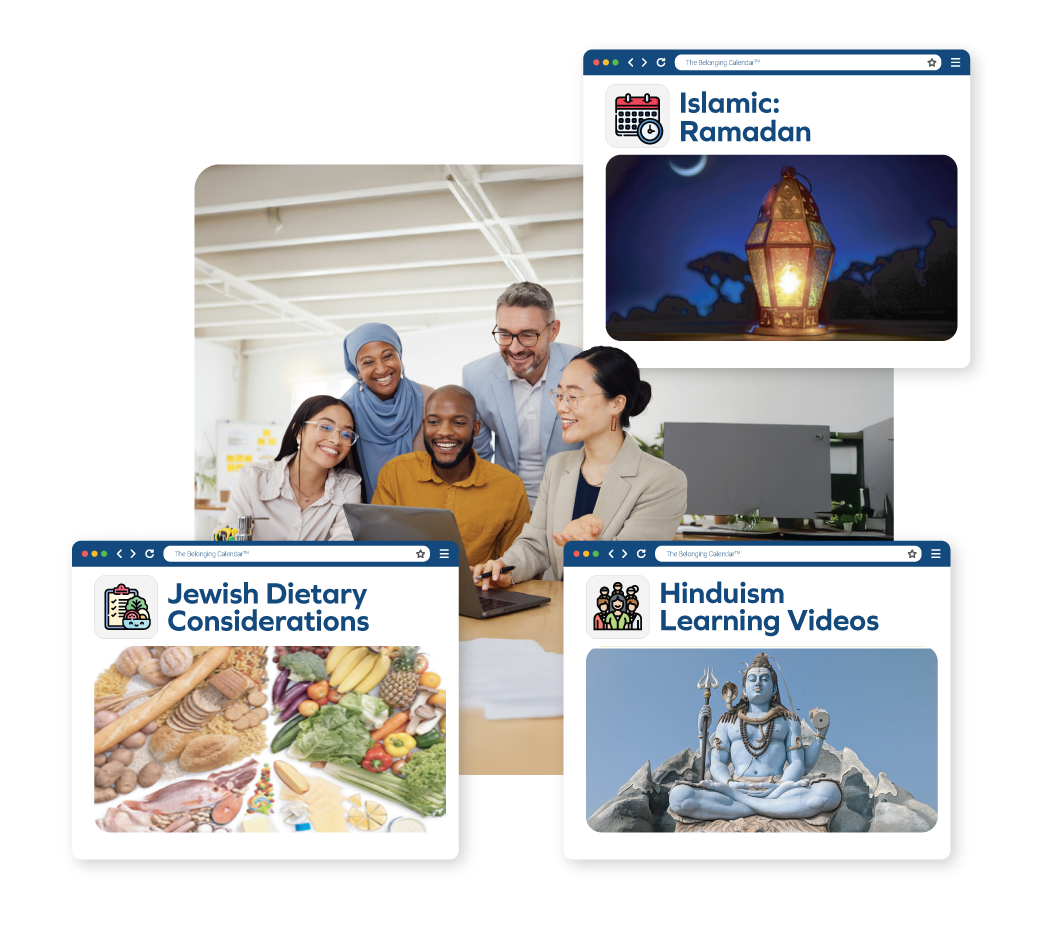
For a full picture, our Belonging Calendar goes beyond a national day calendar to cover religious holidays, awareness days, and commemorative events in one interactive tool. Start a free trial and give your team the dates before the conflicts happen.