


Most HR teams don’t cut their own hair, even though it’s technically something a determined person could learn with enough YouTube tutorials. Some tasks look manageable from a distance and only reveal how much specialized knowledge they require once you’re the one holding the scissors, or the controls, or the spreadsheet. Building a diversity calendar in-house falls into that category more often than most companies expect, and it tends to go wrong in a handful of predictable ways.
At first glance, it looks like a data-entry problem. List the holidays, add the dates, publish it internally, done by lunch. But a diversity calendar isn’t just a list of dates on a shared drive. It’s a public statement about which parts of your employees’ identities and cultures the company actually understands, and it only takes one wrong date or one mispronounced name to undo the goodwill the calendar was supposed to build.
What Actually Belongs on a Diversity Calendar
A workable calendar usually has to hold at least four different kinds of entries, and they don’t behave the same way.
- Religious observances, like Ramadan, Eid, Diwali, Passover, and Lent, many of which follow lunar or lunisolar calendars and move every year.
- National and civic holidays, like Juneteenth, Indigenous Peoples’ Day, or a home country’s independence day, which carry different weight depending on where your employees are based.
- Heritage and awareness months, like Black History Month, Hispanic Heritage Month, Pride Month, and Disability Pride Month, which span weeks rather than a single day and call for a different kind of planning.
- Cultural festivals, like Lunar New Year, Nowruz, and Dia de los Muertos, tied to specific traditions and etiquette that don’t always translate cleanly into an office setting.
Treating all four categories the same way is usually the first mistake. A one-day religious observance and a month-long awareness campaign need different levels of planning, and a calendar that doesn’t distinguish between them tends to either overwhelm employees with announcements or under-deliver on the ones that matter most.
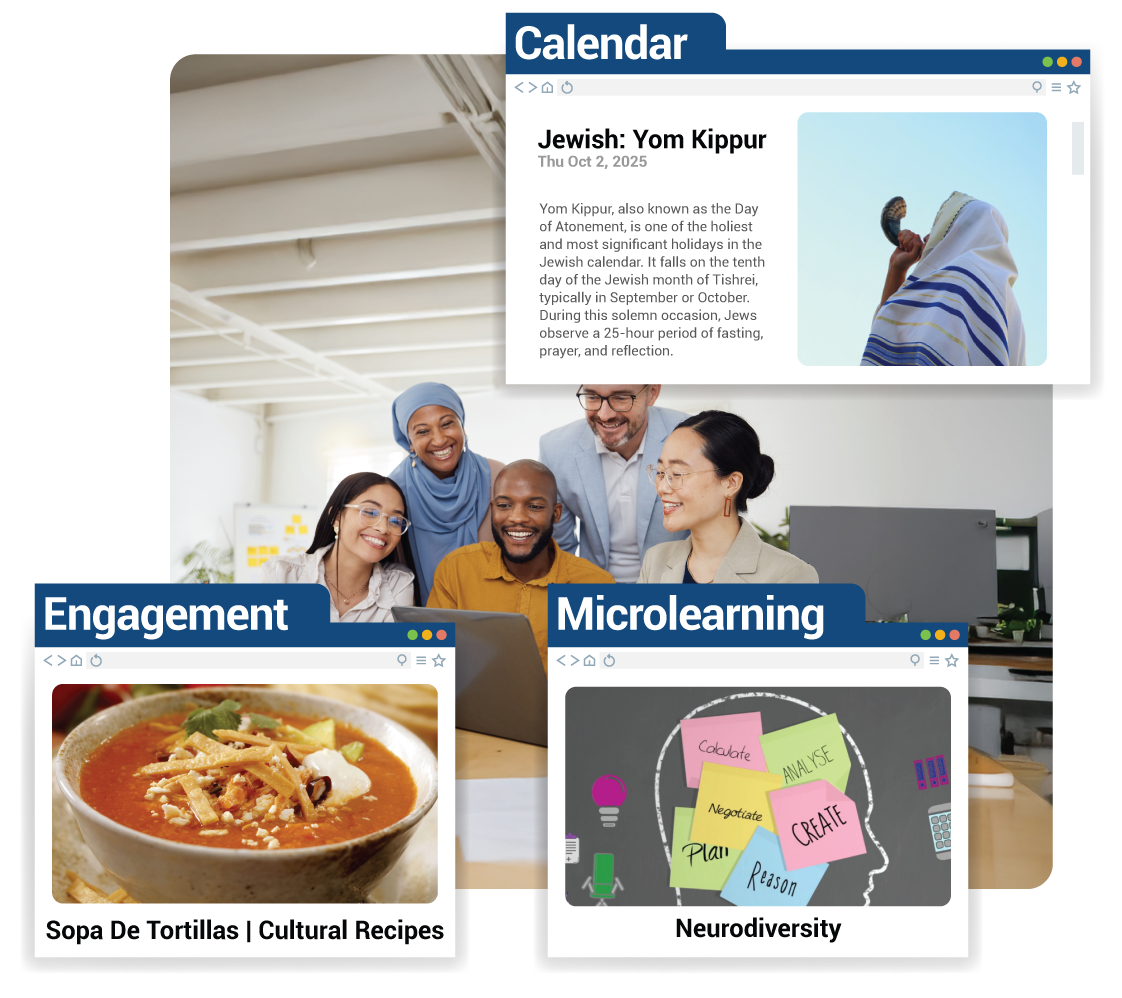
Picking What Matters, Not What’s Easiest to Find
The second decision is which entries get real visibility, and the most reliable answer doesn’t come from a generic list. It comes from knowing the actual composition of your workforce: what countries people are from, what religions are practiced, what regions and cultures show up across the company. A calendar built from that picture will always outperform one pulled from whatever ranks first on Google, because it reflects who’s actually on the team instead of who a search engine assumes is typical.
Getting the Details Right
Even a well-chosen entry can go wrong in the delivery. Pronunciation is the most common failure point. A leader who mispronounces a holiday’s name in an all-hands meeting turns a gesture of recognition into the story employees tell afterward, and that story tends to travel further than the original message did.
Dates Move, and Someone Has to Catch It Every Year
Eid is the clearest example of why a calendar can’t be built once and left alone. It follows the lunar Islamic calendar, and its exact date is often confirmed only when the new moon is sighted, which means the observed date can vary by a day depending on the country or the mosque a person follows. Diwali and Lunar New Year shift for similar reasons tied to lunar and lunisolar calendars. A calendar that isn’t actively maintained will drift out of date within a year or two, usually without anyone noticing until it’s wrong in front of employees.
Even People Who Do This for a Living Keep learning
Erich Toll has led Diversity Resources for years, and he’ll be the first to say he’s still learning new details about specific observances, regional variations, and how recognition lands differently depending on the audience. That’s not a gap in his expertise. It’s the actual shape of this work: it keeps producing new edge cases the longer you pay attention to it. A team member handling this as a side project, on top of their actual job, isn’t going to catch what someone this immersed in the space still catches.
It’s More Labor Than It Looks Like
A credible calendar means researching religious and cultural observances, heritage and awareness periods, international events, dates tied to LGBTQ+, disability, gender, and ethnicity communities, historical milestones, and the correct dates for holidays that follow lunar or religious calendars. Then someone has to write appropriate descriptions, check terminology, and review the entire thing again next year.
Put a number on that and it stops looking like a side task. If an HR or inclusion professional spends even 100 hours a year building and maintaining a calendar like this, at a fully loaded cost of $75 an hour, that’s $7,500 in internal labor before a single piece of content reaches an employee’s inbox.
AI Makes This Look Easier Than It Is
It’s tempting to think generative AI has already solved this. An employee can ask for “500 diversity dates” and have a spreadsheet in five minutes. But generating a list was never the hard part. Someone still has to work out which of those dates are accurate, which ones matter for this specific workforce, which descriptions are appropriate for the organization, which dates have since changed, which entries contain subtle inaccuracies, and what significant observances the tool left out entirely. AI made the rough draft faster. It didn’t reduce the judgment required to turn that draft into something safe to publish.
Accuracy Becomes the Company’s Responsibility
A homemade calendar can end up with wrong dates, outdated terminology, a missing community, or a description that reads as insensitive, and none of those mistakes land the same way a wrong company picnic date would. The moment the calendar goes out under the company’s name, “our HR person Googled this” stops being a good enough answer. A professionally maintained calendar moves that responsibility to a dedicated content operation with actual editorial review behind it.
One Person’s Departure Shouldn’t Take the Calendar With Them
This is one of the most common ways internal projects like this quietly fail. Someone builds the calendar out of good intentions, keeps it going for a year or two, then changes roles or leaves the company. Suddenly nobody knows where the research came from, why certain observances made the cut and others didn’t, when it was last reviewed, or who owns next year’s version. At that point the company hasn’t just lost a calendar. It’s inherited another internal system that someone now has to own indefinitely, without ever agreeing to.
Frequently Asked Questions (FAQs)
How many holidays should a diversity calendar include?
There’s no fixed number. The right size depends on your workforce’s actual composition, not a generic list found online. A calendar with 15 well-chosen, well-explained entries usually serves employees better than one with 60 entries that all get the same one-line treatment.
What’s the difference between a diversity calendar and a cultural calendar?
In practice, the terms are often used interchangeably. Some companies use “cultural calendar” to signal a broader focus on heritage and tradition, while “diversity calendar” more directly ties the effort to workplace diversity and inclusion goals. Either way, the underlying work of research, prioritization, and yearly maintenance is the same.
How often do the dates actually change?
Any holiday tied to a lunar or lunisolar calendar, including Eid, Diwali, Lunar New Year, Rosh Hashanah, and Yom Kippur, moves every year on the Gregorian calendar. That’s a meaningful share of the entries on most calendars, which is why a calendar needs a yearly review, not a one-time build.
None of this means employees shouldn’t be involved. Their most valuable contribution isn’t researching hundreds of global observances from scratch, it’s answering a narrower question: what actually matters to the people on this specific team? A maintained, professionally researched foundation handles the rest. A useful gut check either way is asking how many people are involved in building your calendar this year, and roughly how many hours they’ll spend researching, reviewing, and maintaining it. Once you have that number, the case tends to make itself.